CASE STUDY: GREATER OMAHA CHAMBER OF COMMERCE

CASE STUDY: GREATER OMAHA CHAMBER OF COMMERCE

Bringing accountability and metric discipline to a 73-initiative strategic plan

Bringing accountability and metric discipline to a 73-initiative strategic plan

90%+

Plan Progress Tracked

50%

Less Time Spent Reporting

30 Days

Time to Full Organization-Wide Adoption

Every organization running a serious strategic plan starts in more or less the same place: spreadsheets, shared drives, and one or two dedicated people keeping it all moving.

The Greater Omaha Chamber did that, and did it well, across one of the most ambitious plans in the region, 73 initiatives spanning economic development, workforce, advocacy, and investor engagement.
Together we moved the whole plan into one place, on one scale. In Year 1 more than 90% progress has been tracked, every initiative has an owner, and board reporting takes half the time it used to.

Here is how that came together, and what it really took, because the hard part was never the software.

ORGANIZATION:

Greater Chamber of Commerce

INDUSTRY:

Business & Economic Development

FOCUS AREA:

Strategic Plan Execution & Alignment

SYSTEM REPLACED:

Shared Drive and Spreadsheets

IMPLEMENTATION TIMELINE:

Less than 60 days to full-team rollout

BUSINESS OUTCOME:

Reduced Reporting Burden and Team Wide Engagement

The Challenge

The real challenge: seeing the whole plan at once

A plan this size asks a lot of a team. The Chamber's work spans economic development, workforce, advocacy, and investor engagement, dozens of staff and dozens of initiatives all advancing at the same time. Keeping that current the manual way meant one person tracking down each initiative owner every cycle, gathering updates in whatever format they came in, and assembling it into a single scorecard by hand.

That is real, disciplined work, and it is exactly what most organizations do, because it is what the available tools allow. What no spreadsheet can give you, however capable the person behind it, is a live, shared view of the whole plan that every team measures the same way. That was the gap, and it is a genuinely hard one to close.

"One person was tracking down individual initiative owners across the organization, gathering data that lived in different systems and formats, and then manually compiling it all into a single report. Having information scattered like that made it much harder to track our progress." — Pete Thompson, SVP, Operations & Research, Greater Omaha Chamber
The Solution

Everything in one place, on one scale

The Chamber moved the entire plan into VisionSync: all 73 initiatives, structured under a common framework and measured on one shared scale. VisionSync's onboarding team handled setup and configuration and worked alongside the Chamber to build the plan out, live in under 30 days.

The bigger shift was ownership. Every initiative now has a named owner and a clear definition of done, each one rolling up into a single live view. Instead of one person chasing updates, the people doing the work update their own progress, and leadership sees the whole picture in real time.

To be honest, the software was the straightforward part. The real shift was behavioral: getting every team to agree on what done means, to keep their own progress current, and to be transparent about where things actually stand. That takes willingness, and the Chamber brought it, with leadership setting the tone from the top.

"For the first time, leadership could see the entire plan in one place, measured the same way. That consistency made it easier to have honest conversations about where things stood instead of spending time reconciling different numbers." — Pete Thompson, SVP, Operations & Research

The Solution

Everything in one place, on one scale

The Chamber moved the entire plan into VisionSync: all 73 initiatives, structured under a common framework and measured on one shared scale. VisionSync's onboarding team handled setup and configuration and worked alongside the Chamber to build the plan out, live in under 30 days.

The bigger shift was ownership. Every initiative now has a named owner and a clear definition of done, each one rolling up into a single live view. Instead of one person chasing updates, the people doing the work update their own progress, and leadership sees the whole picture in real time.

To be honest, the software was the straightforward part. The real shift was behavioral: getting every team to agree on what done means, to keep their own progress current, and to be transparent about where things actually stand. That takes willingness, and the Chamber brought it, with leadership setting the tone from the top.

"For the first time, leadership could see the entire plan in one place, measured the same way. That consistency made it easier to have honest conversations about where things stood instead of spending time reconciling different numbers." — Pete Thompson, SVP, Operations & Research

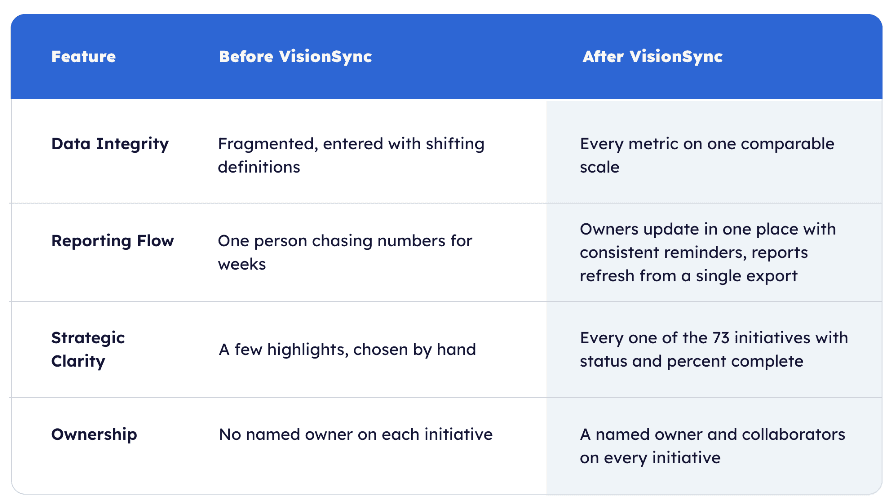
Strategic Clarity

A few highlights, chosen by hand

No named owner on each initiative

Feature

Before VisionSync

After VisionSync

Data Integrity

Reporting Flow

Ownership

Fragmented, entered with shifting definitions

One person chasing numbers for weeks

Every metric on one comparable scale

Owners update in one place with consistent reminders, reports refresh from a single export

Every one of the 73 initiatives with status and percent complete

A named owner and collaborators on every initiative

"For the first time, leadership could see the entire plan in one place, measured the same way. That consistency made it easier to have honest conversations about where things stood instead of spending time reconciling different numbers." — Pete Thompson, SVP, Operations & Research

The Results

A clear view of the whole plan

One number, for the first time. Before, there was no single measure of how far along the plan was, not for any lack of effort, but because the plan simply lived in too many places to add up. In 2025, the Chamber tracked progress on more than 90% of all 73 initiatives, every one on the same scale across different measurement units.

Reporting time cut in half. What used to take several requests and weeks of manual assembly is now a few clicks and a live export. The team went from spending its time collecting the data to spending it discussing the data.

Board-ready by default. Leadership now walks into board meetings with a complete live rollup, not just the highlights someone chose to surface. As Pete put it after the first cycle, "the board could see the entire plan at a glance — a composite score showing overall progress up front, followed by a status update on every one of the 73 initiatives."

Accountability everyone can see. With owners and a shared cadence, staff know exactly what they own and how it ladders up to the plan. The discipline that used to live in one person's spreadsheet now lives in the way the whole organization works.

See VisionSync in Action

See it the way the Chamber does

This is the same live view the Chamber's leadership opens throughout the week: every initiative, every owner, and real-time progress on one scale. Take a two-minute self-guided tour, and see the Chamber's actual 2025 plan dashboard below.

Take the 2-minute tour

Looking Ahead

From tracking to impact

Year 1 was about getting the plan on track: one scale, clear owners, and reporting the board can trust. With that foundation in place, the Chamber's focus shifts from tracking completion to measuring impact, connecting initiative progress to the economic-development outcomes the plan is meant to drive, and using the same live transparency to keep investors and partners confident in where things stand.

The discipline is the point. Once every initiative has an owner, a definition, and a cadence, the plan stops being an annual document and becomes the way the organization runs day to day.

None of this comes from software alone. It comes from a team willing to change how it works, to define, to own, and to be transparent about the parts that used to live in one person's spreadsheet. The Chamber was willing from the very start. As one of our earliest partners, they helped shape what VisionSync has become for complex, mission-driven organizations, and we are grateful they took the chance.

“An effective way to add discipline to reporting on your strategic planning.”

“An effective way to add discipline to reporting on your strategic planning.”

Pete Thompson

SVP, Operations & Research - Greater Omaha Chamber of Commerce

Testimonials

Related Customer Stories

Related Customer Stories

FAQ

Greater Omaha Chamber of Commerce FAQ

Greater Omaha Chamber of Commerce FAQ

How many people at the Greater Omaha Chamber use VisionSync?

How long did the rollout take?

What results has the Chamber seen?

How does VisionSync fit the Chamber's strategic plan?

Who led the work at the Chamber?

Know Where You Stand — Whether You’re 10 or 10,000

Powerful enough for institutions. Simple enough for small teams.

Know Where You Stand — Whether You’re 10 or 10,000

Powerful enough for institutions. Simple enough for small teams.

Know Where You Stand — Whether You’re 10 or 10,000

Powerful enough for institutions. Simple enough for small teams.

Looking Ahead

From tracking to impact

Year 1 was about getting the plan on track: one scale, clear owners, and reporting the board can trust. With that foundation in place, the Chamber's focus shifts from tracking completion to measuring impact, connecting initiative progress to the economic-development outcomes the plan is meant to drive, and using the same live transparency to keep investors and partners confident in where things stand.

The discipline is the point. Once every initiative has an owner, a definition, and a cadence, the plan stops being an annual document and becomes the way the organization runs day to day.

None of this comes from software alone. It comes from a team willing to change how it works, to define, to own, and to be transparent about the parts that used to live in one person's spreadsheet. The Chamber was willing from the very start. As one of our earliest partners, they helped shape what VisionSync has become for complex, mission-driven organizations, and we are grateful they took the chance.