
The question I get most from small organizations isn't how to write a strategic plan. It's where to even start.
That's a fair question, and for a long time I would have given the answer most people give, which is start with your goals. Three years of building our own plan and watching other people build theirs has changed my mind.
The key is the order. Build the framework first, then set the goals underneath it.
Hardly anybody starts there, and there's a good reason why.
Everyone starts with a goal list
Get the team in a room, start writing down what you want to accomplish. It's the natural move, because it's where you already live. Your week is tasks and KPIs. Deadlines, dashboards, the number that has to be up by Friday. So when someone says "let's build a plan," the plan comes out looking like more of the same.
Then the next instinct is to work backward from the list. Break each goal into tasks, assign them out, start moving. It feels productive. Things get done. And you end up working on the goals instead of working on the bigger picture. You've built a to-do list with a better name on it.
The framework is where to start. Most people don't realize that, not because it's complicated, but because nothing in the day to day ever asks you to step up out of it.
So what is a framework
Just layers. Everything on one layer lives underneath something on the layer above it, top down, one to many. A theme has a few focus areas under it. A focus area has a few initiatives under it. That's the whole idea.
Here's a piece of our own plan so you can see what that looks like in practice.
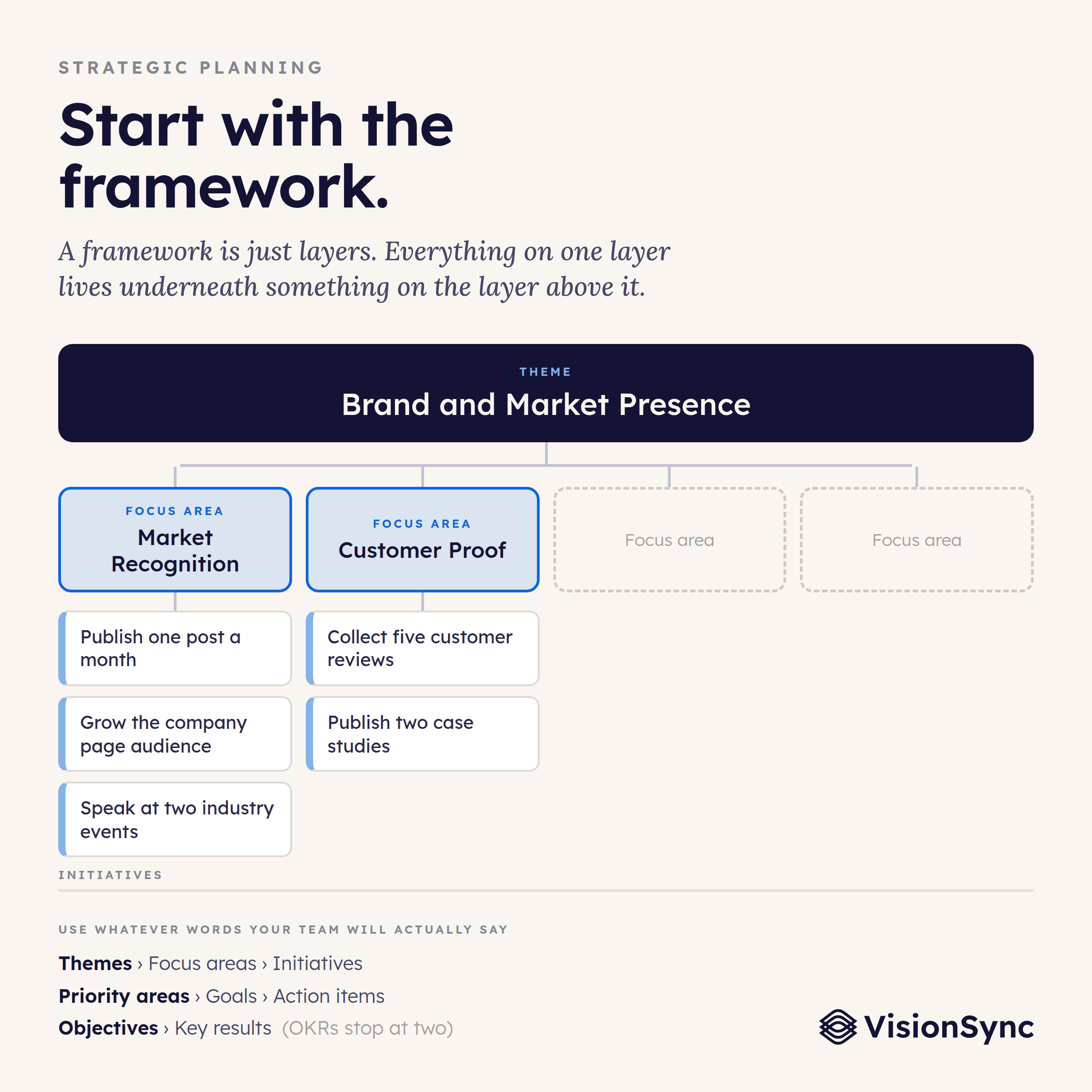
One theme, four focus areas, and the work sitting under the one it belongs to. The post you're reading is one of those initiatives under Market Recognition, which is probably the clearest way I can make the point. It's on the list because it moves market recognition, not because somebody had a content idea in a meeting.
We started a new plan cycle this quarter, so most of this is barely underway. A couple of those initiatives haven't started at all. I'd rather show you a plan in month one than a polished one, because month one is where you are if you're reading this.
Two or three layers is enough for most small organizations. More than that and you'll spend your time maintaining the plan instead of running it.
The words matter less than people think. Pick whatever your team will actually say out loud in a meeting.
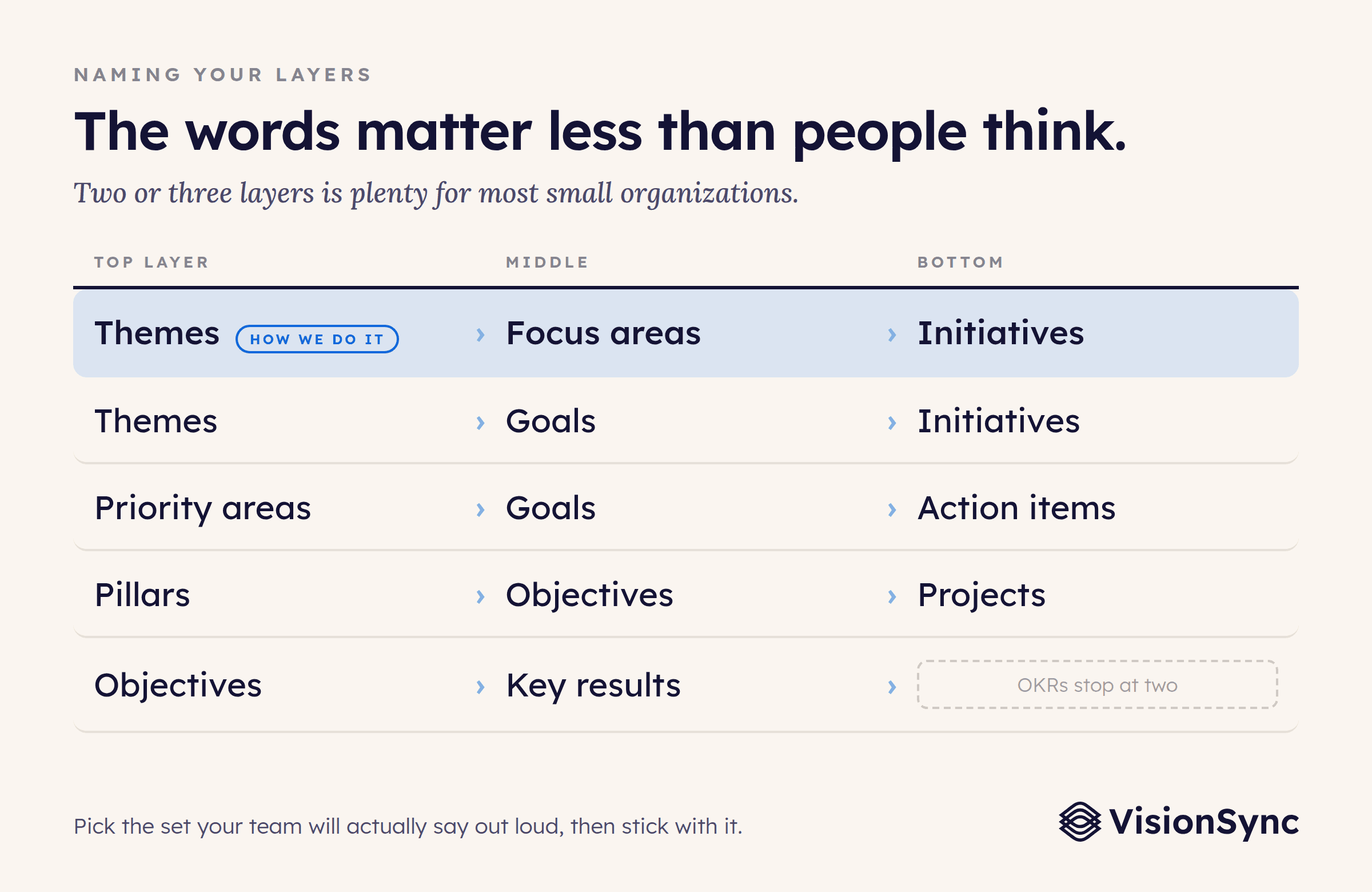
OKRs are a good example of how little depth you really need. Objectives on top, key results underneath, and that's it. Two layers, and plenty of organizations run their whole year on it.
Filling in the top layer
The layers themselves are easy. Deciding what goes in the top one is the work.
Before anybody writes down a goal, get your team to answer a harder question. What has to be true for this organization to be in a meaningfully better place a few years from now?
You'll get more answers than you can carry, and that's fine, because most of the work here is grouping. Lay them all out and you'll notice that a lot of them are the same thing said three different ways. Pull the similar ones together, and the cluster usually names itself. That name is your theme, or your pillar, or your priority area, whatever you decided to call the top layer.
Consolidating is the whole point of the exercise. If you come out with nine themes you haven't really done it yet, you've just relabeled the list you walked in with. A handful of answers, not everything you care about. It might be financial sustainability. It might be reputation in the community, talent and retention, service quality, or some system that's quietly holding everything else back. You'll know you have the right ones when the rest of the work starts hanging off of them.
This is the part that feels the least productive while you're doing it, especially if you're used to moving fast. Stick with it anyway, because everything after it gets easier once the top layer has names.
That's the part worth knowing before you start. It cascades. Once you've named something like Market Recognition and put it on the board, it gets a lot easier to look at your second layer and see what belongs underneath it and what doesn't. Then the initiatives more or less determine themselves, because you already know what they're supposed to move.
What about starting with the goals you already have?
After this post went up, someone asked a good question. Can't you use the goals you already have to start building the framework?
You can. Put every goal and project on a sticky note, get them all up on a wall, and start pulling the ones that belong together into groups. That's called affinity diagramming, and it's a solid way to land on your themes. It's the same kind of grouping I described above, just with a different pile of notes.
What I'd tell you is that the pile you start with shapes what you get back. Group the goals and tasks you already have, and the framework tends to come out looking a lot like the work you're already doing, sorted into neater buckets. That can still be useful, it just leaves very little room for anything new.
Start with the framework and people are usually surprised by the outcome. The top layer comes out of that "what has to be true" conversation, so some of what lands there won't match anything on your current list. From there you're linking real effort to plan elements that are new, that came up organically from your own team, and that are unique to your organization and the people in it.
And you can still use the goals you walked in with. Once the framework is in place, bring them back into the room. Most of them will find a home under something you named, and the ones that don't are worth a conversation, which I'll get to in a minute.
Then set the goals
Now you can get everybody back in the room for the exercise they wanted to do on day one.
Try to get to ten. It's harder than you think.
Setting a bunch of to dos and tasks and KPIs is easy, you can fill a whiteboard in an afternoon. Setting ten goals that connect real work back to a framework is a lot harder, because each one has to sit under a theme and you have to be able to say what it moves. If you can't say which theme a goal belongs to, that's usually your answer about whether it belongs in the plan.
It takes longer than a brainstorm. But the results are a lot more rewarding and a lot more connected, because everything you end up with traces back to something your team already decided mattered.
And then the work sorts itself
Here's the part that surprises people. Once the top layer or two is set, you don't really have to assign the rest of the work. Somebody brings up the project they've been pushing for months, everyone can see which focus area it sits under, and it goes there.
What's more useful is what happens when something doesn't fit anywhere. That's not automatically a reason to kill it, but it's worth a conversation. Does this fit in the plan? If nobody can point to the goal it serves, you've probably found work that's running on momentum rather than intent, and that's a good thing to learn in a planning session instead of at the end of the year.
Whatever language you land on, that's the takeaway. Start with the framework, get your top layer or two written down, and let the work find its bucket.
Do it in sessions, not one sitting
None of this happens in an afternoon, and it shouldn't. Break it up and work it as a team over a few dedicated sessions. Naming your top layer is one kind of conversation, setting goals underneath it is another, and sorting the initiatives goes better when people have had a week to sit with what you built.
Working it this way also changes who gets to be part of it. Strategy has a reputation for being a leadership exercise that gets handed down, and that's how a lot of people have experienced it. When you run it in sessions with your team, it turns into something closer to empowering. People can see where their work connects to the bigger picture, and they can engage at whatever level makes sense for their role.
And you end up with a board report
This is the part nobody plans for.
Once your themes, your focus areas, and the initiatives underneath them all live in one place, you also have a board report. For a lot of smaller organizations that's something you may not have had before, at least not one built on real progress rather than a narrative.
If you've got an advisory board, this changes those meetings. Instead of an update they have to take your word on, they can see what's actually moved and what's stuck. Which means they can also see where they're able to help, whether that's their network, their experience, or an introduction they're in a position to make. A board that can see the framework will stay engaged with it.
It's less daunting than it looks
Most of the hard part is the blank page. Once you break it into steps and work it in sessions, it turns into a series of decisions you were already making informally, just made out loud with your team in the room.
You don't need a perfect plan to get going. You need a few honest hours, a top layer with a handful of things that genuinely matter to your organization, and ten goals that connect back to them. The rest will find its place.
And a month in, when somebody asks why you're spending time on a blog post, you'll have an answer.
About the Author