

If you've seen Shrek, you probably remember the scene. Shrek is trying to explain that ogres are like onions, because they have layers, and Donkey isn't buying it. He suggests cake instead, and then parfait, because everybody likes parfait.
It's a silly scene, and it also happens to be a pretty good way to describe a university.
Every university has layers
At the center you've got the president and the cabinet, and that's usually where the strategic plan gets written. Around that you have campuses, if you're part of a system. Then colleges and schools. Then departments and programs. Then institutes, centers, and offices, and plenty of those don't fit neatly under any one college. On the very outside are the faculty and staff doing the actual work.
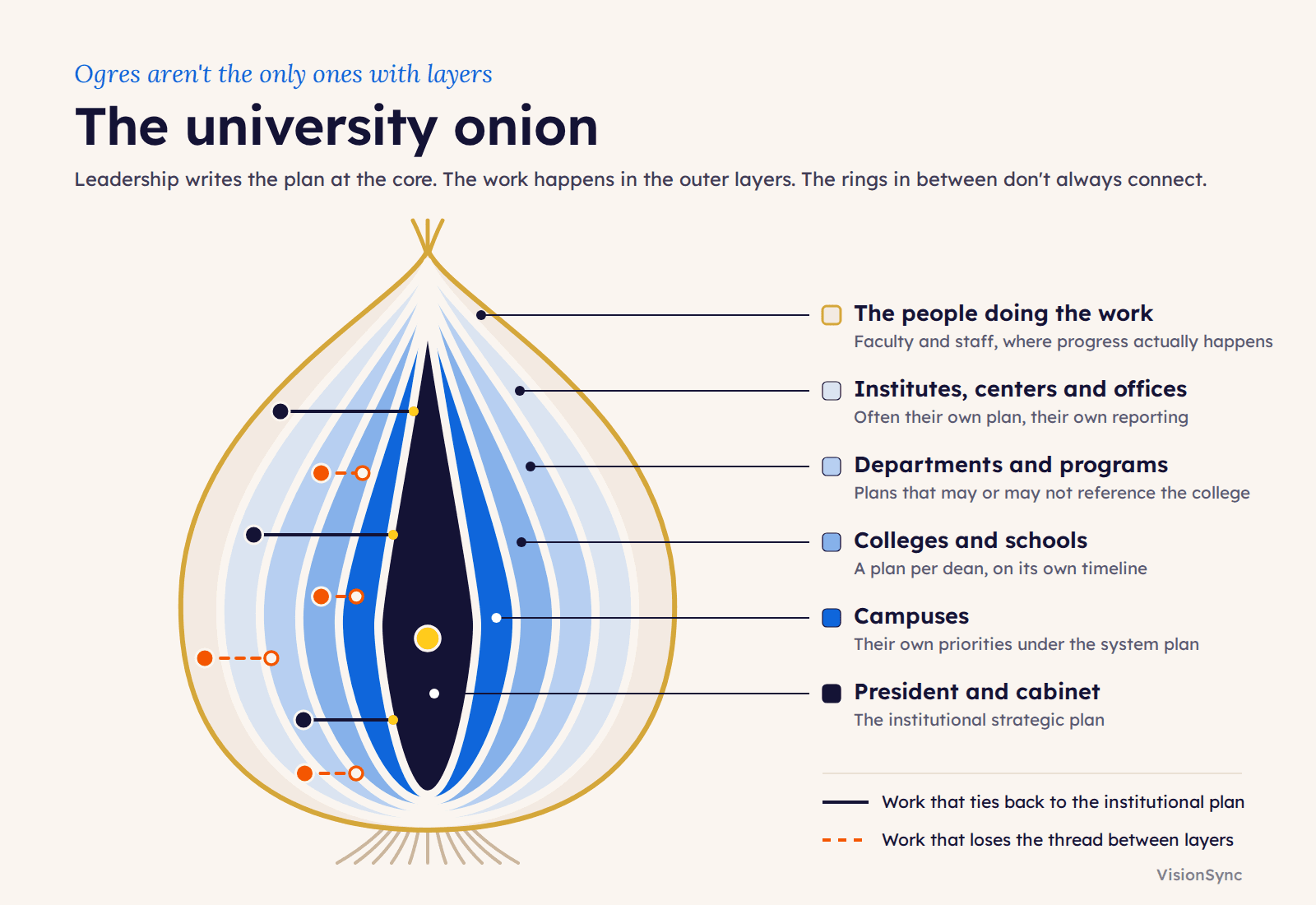
And the layers keep going. At some universities even the structure depends on who you ask, because the finance system has one version of the hierarchy and the academic side has another.
The layers themselves are fine, a university needs them and each one exists for a good reason. Things get tricky when the plan has to travel through all of them.
The core assumes the plan made it to the outside
When leadership finishes a strategic plan, there's a natural assumption that it moves outward from there. Each layer picks it up, interprets it for their area, builds their own plan underneath it, and everybody feels connected to the same direction.
That's typically not how it plays out. Some layers connect and work together really well. Others stay out on the edge and never quite tie back to the core. A college writes its plan on its own timeline. A center reports to its funders in its own format. A department sets goals that make a lot of sense for the department, and nobody's quite sure which institutional priority they're supposed to support.
Usually everyone in those layers is doing good work and doing exactly what they were asked to do. What's missing is an easy way to see how their piece fits with the layers around it.
Connecting the layers by hand
On paper, the strategic plans are what connect all of it. The institutional plan sits at the core, the campus and college plans link to it, and the department and unit plans link to those. Follow the thread from any initiative out on the edge and you should be able to get all the way back to the middle.
Doing that manually is very difficult. Every layer has its own plan, in its own format, updated on its own schedule, by its own people. When it's time to report, somebody sends out a request, the updates come back in a dozen different shapes, and somebody else spends a lot of hours stitching them into something leadership can read. By the time the report reaches the core, it's describing a quarter that's already over.
That's the onion problem. You can see what's inside, you just have to peel it apart one layer at a time, and somebody usually ends up in tears.
A few signs your layers aren't connected
College and department plans don't mention the institutional plan, or mention it once on the first page and never again.
Update season means chasing spreadsheets and email threads.
The same initiative gets reported three different ways by three different offices.
People in the outer layers can't say which institutional goal their work supports.
The board or cabinet report gets built by hand, and it covers a few highlights instead of the whole plan.
If a couple of those sound familiar, that's pretty normal for an organization with this many layers.
The tools I hear about most
When I talk with universities about how they keep track of all this, the same handful of tools come up. Each one is good at something, and it's worth being fair about that. They tend to struggle once the layers pile up.
Excel, Google Sheets, and SharePoint. Everyone already has them, they're flexible, and nobody needs training. The catch is that every layer builds its own version. Rolling it up means copying and pasting between files, and it's hard to tell which version is current or who changed what.
Word or PDF plans and PowerPoint decks. These are great for publishing the plan and telling the story to a board. They're frozen the moment they're saved, though, so every update turns into a new narrative written from scratch instead of a view of what actually moved.
Project tools like Smartsheet, Asana, or Monday. Really good at managing tasks and deadlines inside a team. They're built around projects that start and finish, so a multi-year plan with goals at the institutional level and initiatives three layers down gets awkward fast, and every unit tends to set theirs up a little differently. Leadership ends up looking at a lot of tasks when what they wanted to see was the strategy.
BI dashboards like Power BI or Tableau. Great for the numbers you already collect, like enrollment, retention, and research dollars. What a dashboard can't pull on its own is whether an initiative is actually moving, because that's a judgment call that lives with the people doing the work, spread across a lot of departments. Most of them also need a data team to build and keep up.
Each of these does a nice job inside a single layer, and a lot of universities end up using three or four of them at once, which is right about where all the stitching comes in.
Donkey had a point about parfait
A parfait has layers too. It just comes in a clear glass, so you can see every layer at once, and when you dig in, one spoon goes through all of them. And every spoonful gets a little of each layer, which is about what a good board report should feel like.
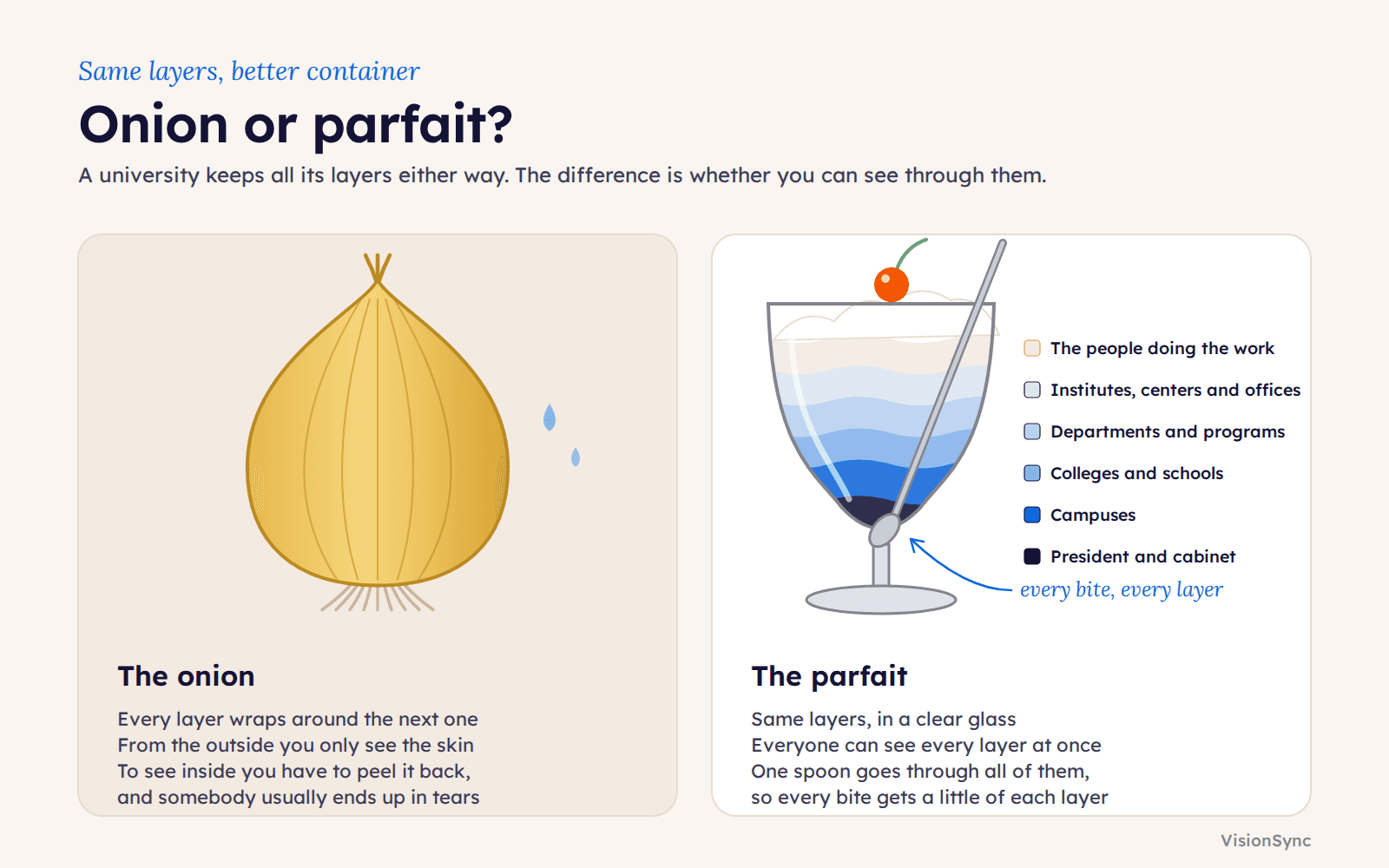
I'd say that's the better picture of what a university plan can look like. You keep every layer. Campuses, colleges, departments, and centers all keep their own plans and their own ownership. What changes is the container. When all of those plans live in one place and link to each other, anybody can look through the glass and see how the outside connects to the core.
What that looks like in VisionSync
That's a big part of what VisionSync does. The institutional plan sits at the top, and each campus, college, or department builds its piece underneath and links it to the goals it supports. The people closest to the work post their own progress updates, with reminders so nobody has to chase them down. Leadership gets one live view across every layer, and board-ready reports come straight out of it instead of being assembled by hand.
The University of Nebraska is a good example of how far that can stretch. Dr. Gold's team manages more than 1,200 initiatives across four campuses in one live view.
And I'd say it gets more powerful the further down the layers you get people engaged, because the people on the outside can finally see where their work connects to the core.
Where to start
You can start untangling your own onion before you ever look at software. Here are a few things to try this quarter.
Draw your onion. List every layer that has a plan, or probably should. You might find more than you expected.
Pick the connection points. Every plan in an outer layer should be able to name the institutional goal it supports. If it can't, that's a good conversation to have, and it's the same question we talked about in where to start your first strategic plan.
Agree on the words. Use the same names for the layers everywhere, so a goal in the College of Business means the same thing as a goal in the provost's office.
Let the people doing the work report the progress. The closer the update is to the work, the more current and accurate it's going to be.
Look at it together on a regular rhythm. Quarterly works well for a lot of institutions, and we wrote more about that in the case for quarterly strategic reviews.
Universities are always going to have layers, and that's alright. Put them in a clear glass and hand everybody a spoon.
About the Author